
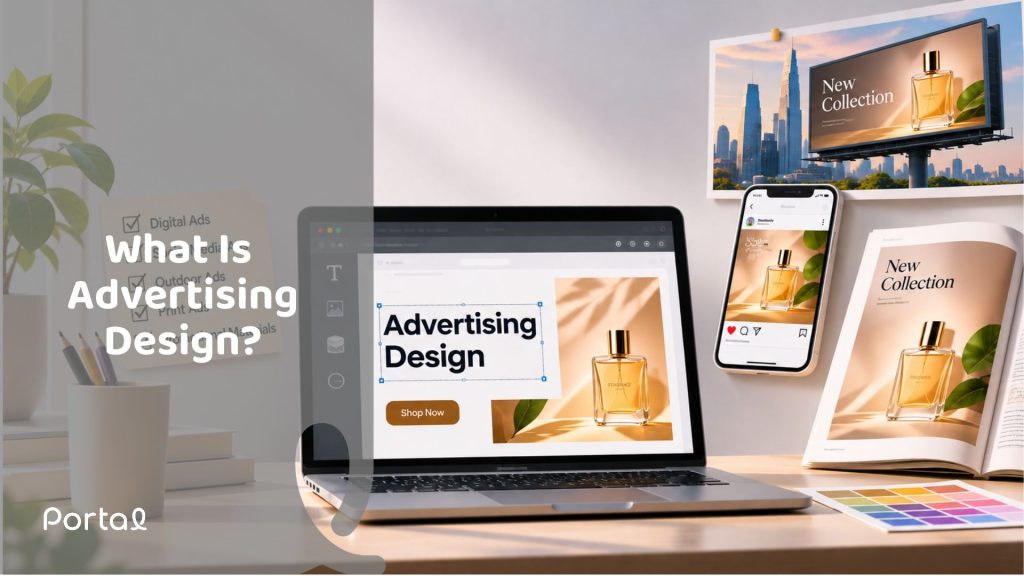
A good advertisement needs more than an eye-catching image. It needs a clear message, the right visuals, and a design that connects with its audience.
Advertising design brings these elements together to promote products, services, and brands across digital, print, and outdoor channels. But what makes an advertising design effective, and how does it change from one format to another?
What Is Advertising Design?
Advertising design is a specialized area of graphic design created for promotional campaigns. It uses typography, images, colors, layout, copy, and brand elements to communicate with a specific audience.
Every advertising design starts with a goal. A business might want to introduce a new product, promote an offer, build brand awareness, or encourage customers to take action.
Creative advertising design is not simply about making an advertisement look attractive. It turns a marketing message into a clear and memorable visual concept.
Before creating the advertisement, the designer needs to understand the product or service, the target audience, its main benefit, where the advertisement will appear, and what action the customer should take. These details guide the message, visual direction, layout, and advertising format.
Why Is Advertising Design Important for Businesses?
People come across advertisements every day, but not every ad gets their attention. A clear, well-designed advertisement helps businesses communicate their message and make their products or services easier to recognize.
Good advertising design also helps a brand stand out from competitors. Using consistent colors, visual elements, and messaging across digital, print, and outdoor channels makes the brand easier to identify and gives the campaign a connected, professional appearance.
Its value goes beyond appearance. Professional advertising services combine clear messaging with effective visuals to guide potential customers toward the next step, whether that means visiting a website, asking about a service, or making a purchase.
What Are the Main Types of Advertising Design?
The right advertising design depends on where the ad appears, how the audience interacts with it, and the nature of the advertising channel. The main types include Digital Advertising Design, Outdoor Advertising Design, Print Advertising Design, and Promotional Materials Design. Each type requires a different approach to layout, content, and visual communication.
Digital Advertising Design
Digital advertising design covers advertisements created for online platforms, including:
- Social media ads.
- Website banners.
- Display advertising.
- Mobile ads.
- Email advertising.
- Video and motion ads.
- Retargeting ads.
- E-commerce campaign visuals.
Digital advertising must communicate quickly, especially on mobile screens. The headline, main visual, brand, and offer should be easy to recognize before the user scrolls away.
Digital advertisements must be adapted to different dimensions and placements. Simply resizing one visual can produce cropped images, unreadable text, or weak layouts. A better approach is to create a flexible advertising design system that keeps the campaign idea consistent while adapting the composition to each format.
Digital platforms also allow advertisers to test different ad creative design variations. Teams can compare headlines, visuals, offers, colors, and calls to action to understand which combination is most relevant to the audience.
Social Media Advertising Design
Social media advertising design includes paid image, carousel, story, and video ads created for social platforms. Each placement needs readable text, a clear visual focus, recognizable branding, and a relevant call to action.
Social media ads design should also match the platform. An Instagram advertisement may need a strong image or short video, while a LinkedIn advertisement may use a more professional tone and clearer business message.
The composition should suit the placement’s dimensions and viewing experience, keeping key messages and brand elements clear on mobile screens.
Outdoor Advertising Design
Outdoor advertising includes:
- Billboards.
- Digital billboards.
- Building wraps.
- Bus shelters.
- Transit advertising.
- Mall displays.
- Roadside signs.
- Outdoor banners.
People often see outdoor advertisements from a distance and for only a few seconds. Outdoor advertising design must therefore be bold, simple, and immediately understandable.
An effective billboard usually contains:
- One clear idea.
- A short headline.
- A strong visual.
- Readable typography.
- Recognizable branding.
- Minimal supporting information.
The design should consider viewing distance, traffic speed, lighting, location, and surrounding visual noise. A detailed layout that works in a brochure will not work on a roadside billboard.
Outdoor advertising should not look like an enlarged flyer. Its strength comes from simplicity, scale, and a memorable creative concept.
Print Advertising Design
Print advertising design includes:
- Magazine advertisements.
- Newspaper advertisements.
- Posters.
- Flyers.
- Leaflets.
- Catalogs.
- Direct mail.
- Product inserts.
Print advertisements can contain more information than social media ads or billboards because readers may spend more time examining them.
However, the main message must still be clear. A strong print advertisement guides the reader from the headline and visual to the supporting information and call to action.
Print advert design must also consider technical requirements such as:
- Document dimensions.
- Bleed and safe margins.
- Image resolution.
- Print color settings.
- Paper type.
- Finishing options.
Correct preparation ensures that the printed advertisement looks professional and accurately represents the brand.
Broadcast advertising.
Broadcast advertising covers television and radio commercials. Advertising design brings together visuals, motion graphics, on-screen typography, scripts, and sound to communicate a campaign message within a limited running time.
Television advertisements need a clear visual story, recognizable branding, and a focused call to action. Radio advertising relies on copy, voice, music, and sound rather than graphic design, while any supporting campaign visuals should maintain the same brand identity.
Direct mail advertising.
Direct mail advertising delivers printed promotional materials to a selected audience by post. Common formats include postcards, letters, brochures, catalogs, and personalized offers.
Effective direct mail advertising design combines a strong headline, relevant imagery, clear offer details, and an easy next step, such as visiting a landing page, scanning a QR code, or contacting the business. The layout should make the main benefit immediately visible and keep response details easy to find.
Point-of-sale and promotional advertising.
Point-of-sale advertising reaches customers where they browse or buy, using shelf displays, counter stands, in-store posters, and offer signage. Clear typography, recognizable branding, and accurate promotion details help shoppers identify the offer quickly.
Promotional materials support campaigns, events, product launches, retail promotions, and sales activities. They may include:
- Brochures.
- Product catalogs.
- Sales sheets.
- Exhibition graphics.
- Point-of-sale displays.
- Roll-up banners.
- Promotional packaging.
- Branded merchandise.
- Coupons and vouchers.
These materials should feel connected to the main advertising campaign. They can use different layouts, but the campaign colors, typography, imagery, and key message should remain consistent.
Promotional materials often contain more detailed information. The design must organize that information clearly without losing the main campaign idea.

What Makes an Effective Advertising Design?
The main advertising design principles are clarity, hierarchy, relevance, readability, brand consistency, and a clear call to action.
Effective creative advertising design does not add visual elements without a reason. Every element should support the message, brand, audience, or intended action.
A Clear Advertising Message
Every advertisement should communicate one primary message. Trying to include many unrelated benefits in one design makes the advertisement confusing.
The headline, image, and copy should communicate the same idea. If the headline makes one promise while the image suggests something different, the audience may not understand the advertisement.
A clear message can still be creative. Simplicity does not mean producing a boring advertisement. It means presenting an original idea in a form that people can understand quickly.
Strong Visual Hierarchy
Visual hierarchy determines what the audience sees first, second, and third.
A typical advertisement may include:
- The main headline or visual.
- The product, service, or offer.
- Supporting information.
- The call to action.
- The brand logo.
Designers create hierarchy through size, position, contrast, color, typography, and spacing.
When every element is large or bold, all parts compete for attention. Strong advertising graphic design gives priority to the most important information.
Consistent Brand Identity
An advertisement should be recognizable as part of the brand. Consistency may include:
- Logo usage.
- Brand colors.
- Typography.
- Photography or illustration style.
- Tone of voice.
- Graphic elements.
- Product presentation.
Brand consistency does not mean repeating the same layout in every campaign. Creative advertising services can develop new ideas while maintaining the brand’s recognizable identity.
A Clear Call to Action
A call to action tells people what to do next. Examples include:
- Shop now.
- Learn more.
- Request a quote.
- Book a consultation.
- Visit our store.
- Register now.
- Contact us.
The CTA must match the campaign objective. “Buy Now” may suit a direct product offer, while “Learn More” may be more appropriate for a complex service.
The call to action should be visible, concise, and connected to the promise made by the advertisement.
Design Adapted to Each Format
The campaign idea and visual identity should remain consistent across channels, while the layout, content, dimensions, and call to action are adapted to each platform and viewing experience.
Advertising Design Examples
Imagine a fragrance brand promoting a new perfume on Instagram. The advertisement could feature a clear, attractive product image, a short headline describing the fragrance or its main notes, and a visible “Shop Now” button. Brand colors and refined typography would help the ad feel distinctive while keeping the product and message easy to understand on a mobile screen.
For an outdoor example, a car company launching a new electric vehicle could use a large image of the car, a short headline about its driving range, and the brand logo. With only a few seconds to reach drivers and pedestrians, the billboard would avoid detailed specifications and focus on one memorable benefit.
In print advertising, a financial services company promoting a business loan could use a confident headline, professional photography, a concise explanation of the service, and a QR code leading to an application page. The layout could include more detail than a billboard while guiding the reader clearly from the main benefit to the next step.
For promotional materials, a skincare brand launching a new product line could carry one key visual across brochures, retail displays, product cards, and event banners. Each item would adapt the amount of information to its purpose while retaining the same colors, imagery, typography, and campaign message.
How Does the Advertising Design Process Work?
A professional advertising design process includes six main stages:
- Define the objective.
- Understand the audience.
- Prepare the brief.
- Develop the concept.
- Design and adapt the campaign.
- Review and deliver.
Advertising Design vs. Graphic Design
Understanding advertising design vs. graphic design helps businesses choose the right creative service.
Graphic design is the broader field of visual communication. It includes branding, packaging, editorial design, user interfaces, publications, signage, and advertising.
Advertising design is a specialized application of graphic design focused on promotional campaigns.
| Area | Advertising Design | Graphic Design |
| Main purpose | Promote or encourage action | Communicate visually |
| Typical work | Ads, billboards, banners, and campaign visuals | Logos, packaging, books, interfaces, and more |
| Starting point | Campaign objective and audience | Communication objective |
| CTA | Frequently required | Not always required |
| Performance | Connected to campaign goals | Depends on project purpose |
The Portal Agency develops advertising design and creative campaigns built around clear messages, distinctive visual concepts, and consistent execution across digital, print, outdoor, and promotional channels.
Frequently Asked Questions About Advertising Design
What are the 7 types of advertising?
Seven common types are:
- Digital advertising.
- Social media advertising.
- Print advertising.
- Outdoor advertising.
- Broadcast advertising.
- Direct mail advertising.
- Point-of-sale and promotional advertising.
What are the 7 types of design?
Seven common disciplines are brand identity, advertising graphic design, marketing and promotional design, digital and web design, publication and editorial design, packaging design, and environmental and signage design.
How to do advertisement design?
Define the objective and audience, choose one message, develop a headline and visual concept, apply clear hierarchy and branding, add a CTA, then adapt, test, and refine the design.
Can you give me some examples of advertising design?
Examples include social media ads, website banners, video ads, email graphics, print ads, billboards, brochures, point-of-sale displays, and product launch campaign visuals.
What are advertising design services?
Advertising design services include creative concepts, campaign design, key visuals, digital and social media ads, outdoor and print advertising, motion graphics, and promotional materials.
What are the main advertising design principles?
The main principles are message clarity, visual hierarchy, audience relevance, readability, brand consistency, format adaptation, and a clear call to action.
Is advertising design the same as graphic design?
Advertising design is a specialized part of graphic design focused on promotional campaigns, target audiences, and marketing objectives.
How do I choose an advertising design company?
Look for strategic thinking, relevant campaign experience, strong creative concepts, a quality portfolio, brand understanding, and consistent execution across advertising channels.
What is the difference between advertising design and advertising strategy?
Advertising strategy defines the campaign objective, audience, message, channels, and budget. Advertising design turns that strategy into a clear and engaging visual advertisement.
Can the same advertising design be used across different platforms?
The same campaign idea and visual identity can be used across platforms, but the design should be adapted. Its dimensions, layout, amount of text, and CTA placement should suit each platform.